
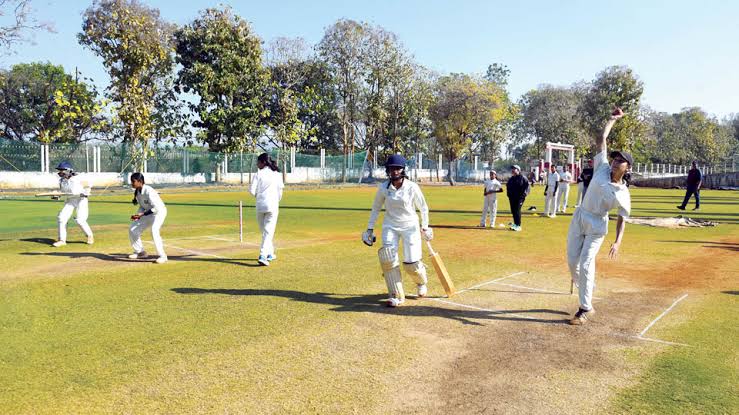
No. Women’s senior international cricket uses the same standard pitch length as men’s cricket: 22 yards (66 feet or approximately 20.12 metres). The main differences are in cricket ball specifications, boundary dimensions and fielding restrictions.
For a complete explanation of standard pitch measurements and crease markings, read our cricket pitch length guide. This article focuses on the equipment and playing-condition differences specific to women’s cricket.
Men’s vs Women’s Cricket: Key Differences
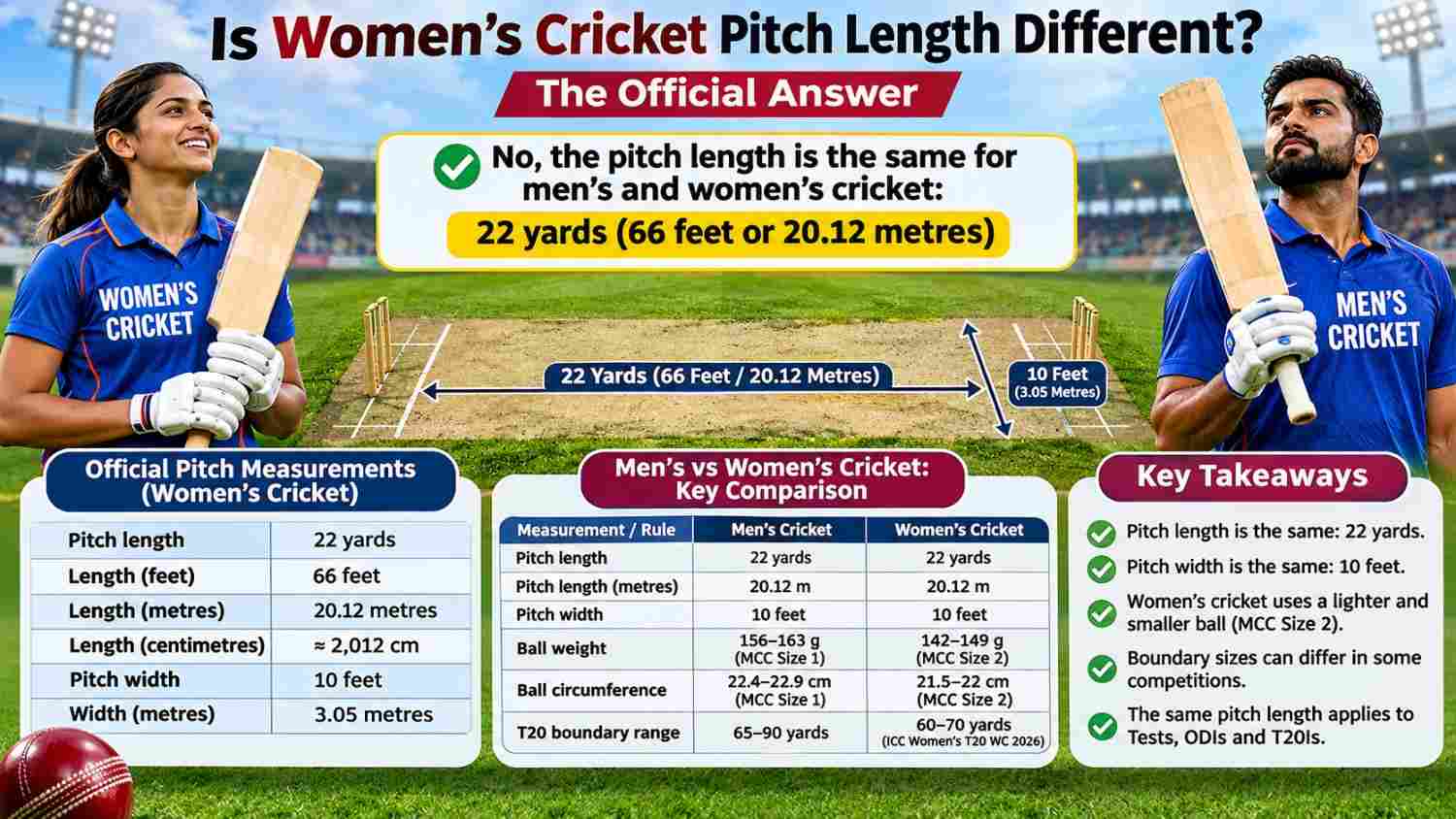
The following table compares the main pitch-related measurements and playing conditions in men’s and women’s senior international cricket.
| Measurement or Rule | Men’s Cricket | Women’s Cricket |
| Pitch length | 22 yards | 22 yards |
| Pitch width | 10 feet | 10 feet |
| Cricket ball weight | 156–163 g (Size 1) | 142–149 g (Size 2) |
| Cricket ball circumference | 22.4–22.9 cm (Size 1) | 21.5–22 cm (Size 2) |
| International T20 boundary range | Generally 65–90 yards | 60–70 yards, with qualifying older-venue exemption |
| Fielding restriction circle radius | 30 yards | 25.15 yards |
| Maximum fielders outside the circle in non-powerplay overs | 5 | 4 |
The standard pitch dimensions are identical. The differences relate to the ball used and certain competition-specific playing conditions.
1. Women’s Cricket Ball Size and Weight
One of the main equipment differences between men’s and women’s cricket has traditionally been the size and weight of the ball.
The MCC introduced revised ball-size categories in its 2026 edition of the Laws of Cricket, effective from 1 October 2026. The new categories are Size 1, Size 2 and Size 3. They replace the previous men’s, women’s and junior terminology.
Under MCC Law 4.1, the specifications are:
| Ball Category | Weight | Circumference |
| Size 1 | 156–163 grams | 22.4–22.9 cm |
| Size 2 | 142–149 grams | 21.5–22 cm |
| Size 3 | 133–140 grams | 20.5–21 cm |
Size 1 corresponds to the former men’s ball category, while Size 2 corresponds to the former women’s category. The applicable competition playing conditions determine which category is used in a particular match.
Why Did MCC Change the Cricket Ball Categories in 2026?
The MCC revised Law 4.1 to introduce three standardised ball categories.
Previously, the smaller women’s and junior balls had much wider permitted size and weight ranges than the men’s ball, despite being smaller. This resulted in less consistent manufacturing tolerances.
The 2026 changes tightened the specifications for Size 2 and Size 3 balls. All three categories now have a consistent weight tolerance of 7 grams and a circumference tolerance of 0.5 centimetres.
The changes were developed in consultation with manufacturers and current and former women’s cricket players through the MCC’s World Cricket Connects initiative.
Another important change is that all three ball categories are now included together in Law 4.1. Previously, the smaller ball categories were covered separately under Law 4.6.
The 2026 edition also removes gendered language throughout the Laws of Cricket. This introduces standardised equipment terminology rather than relying on men’s, women’s and junior labels.
These changes do not mean that every men’s and women’s match must use the same ball. The relevant competition playing conditions determine which category is used.
2. Women’s Cricket Boundary Dimensions
Women’s international limited-overs cricket has specific boundary requirements that can differ from men’s competitions.
Under Clause 19.1.3 of the ICC Women’s T20 World Cup 2026 Playing Conditions, the boundary requirements are:
- Maximum boundary: 70 yards (approximately 64 metres).
- Minimum boundary: 60 yards (approximately 54.86 metres).
- Measurement point: From the centre of the pitch.
The regulations use different wording for the two limits. The maximum boundary shall not be longer than 70 yards, while the minimum boundary should not be shorter than 60 yards.
The playing conditions also provide an exemption for previously approved international venues that cannot meet the 60-yard minimum. Under this exemption, a minimum boundary of 55 yards (165 feet) may apply. The boundary should be positioned to maximise the playing area.
For comparison, men’s international T20 cricket generally allows boundary distances between 65 and 90 yards.
These boundary requirements affect the playing area around the pitch. They do not change the standard 22-yard distance between the wickets.
3. Women’s Fielding Circle and Restrictions
The fielding restriction circle is another important difference between men’s and women’s international limited-overs cricket.
In men’s limited-overs cricket, the fielding restriction circle has a radius of 30 yards (90 feet or approximately 27.43 metres).
In women’s international limited-overs cricket, the circle has a radius of 25.15 yards (75.45 feet or approximately 23 metres). This measurement is specified in Clause 28.7.3 of the ICC Women’s T20I Playing Conditions.
The number of fielders allowed outside the circle also differs during non-powerplay overs:
- Men’s cricket: A maximum of five fielders can be outside the circle.
- Women’s cricket: A maximum of four fielders can be outside the circle.
During the powerplay, only two fielders are permitted outside the fielding restriction circle in both men’s and women’s T20I cricket.
These restrictions influence field placements and the balance between batting and bowling. However, they do not affect the length of the cricket pitch.
Does Women’s Test, ODI or T20 Cricket Use a Different Pitch Length?
No. Women’s Test, One Day International and Twenty20 International cricket all use the standard 22-yard pitch.
The match format changes the number of overs, duration and certain playing conditions. It does not change the standard pitch length.
MCC Law 6 establishes the standard pitch dimensions. It does not prescribe a shorter pitch for women’s senior international cricket.
Are There Exceptions to the Standard Women’s Cricket Pitch Length?
Junior and recreational cricket can use modified pitch dimensions under the relevant age-group or competition regulations.
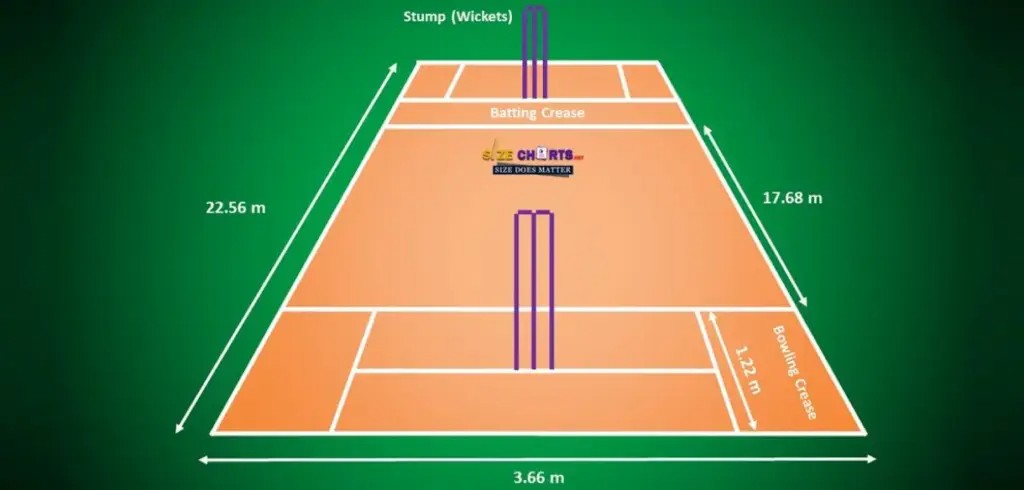
Artificial and non-turf pitches also have separate provisions under the Laws of Cricket. Under MCC Law 6.5, a non-turf cricket pitch must meet these minimum dimensions:
| Measurement | Official Value |
| Minimum length | 58 feet (17.68 metres) |
| Minimum width | 6 feet (1.83 metres) |
These provisions should not be confused with senior women’s international cricket, where the standard pitch remains 22 yards long.
What Do the Official Cricket Rules Say?
Source Image: uccricket
The Marylebone Cricket Club (MCC) is responsible for writing and maintaining the Laws of Cricket.
MCC Law 6 defines the standard dimensions of the cricket pitch. It specifies a length of 22 yards (20.12 metres) and a width of 10 feet (3.05 metres). The Law does not establish a shorter standard pitch for women’s senior international cricket.
The MCC’s 2017 Code, Fourth Edition (2026), came into effect on 1 October 2026. It includes revised cricket ball specifications under Law 4.1.
The International Cricket Council (ICC) publishes separate playing conditions for men’s and women’s international competitions. These conditions cover matters such as boundary dimensions and fielding restrictions while applying the relevant Laws of Cricket.
For Indian domestic cricket, the Board of Control for Cricket in India (BCCI) also publishes playing conditions for its men’s and women’s competitions.
Conclusion
Women’s senior international cricket uses the same standard pitch length as men’s cricket: 22 yards (66 feet or approximately 20.12 metres).
The main differences are in equipment and playing conditions. The MCC’s 2026 Laws introduce three ball categories under Law 4.1, while women’s international limited-overs cricket has specific boundary requirements and a 25.15-yard fielding restriction circle.
The maximum number of fielders outside the circle during non-powerplay overs is also different: five in men’s cricket and four in women’s cricket.
These differences affect how the game is played, but they do not change the standard distance between the wickets.
Frequently Asked Questions (FAQs)
The standard women’s senior international cricket pitch is 22 yards long. This is equal to 66 feet or approximately 20.12 metres.
No. Both men’s and women’s senior international cricket use the same 22-yard pitch. There is no standard reduction in pitch length for women’s cricket.
The standard cricket pitch is 10 feet (3.05 metres) wide. This measurement is the same in men’s and women’s senior international cricket.
No. Women’s T20 International cricket uses the same 22-yard pitch as men’s T20 International cricket. The format does not change the standard pitch dimensions.
Women’s cricket has traditionally used a lighter and smaller ball than men’s cricket. Under the MCC’s 2026 Laws, the ball specifications are organised into three categories. Size 2 corresponds to the former women’s category and weighs between 142 and 149 grams, with a circumference of 21.5 to 22 centimetres. The applicable competition playing conditions determine which ball category is used.