
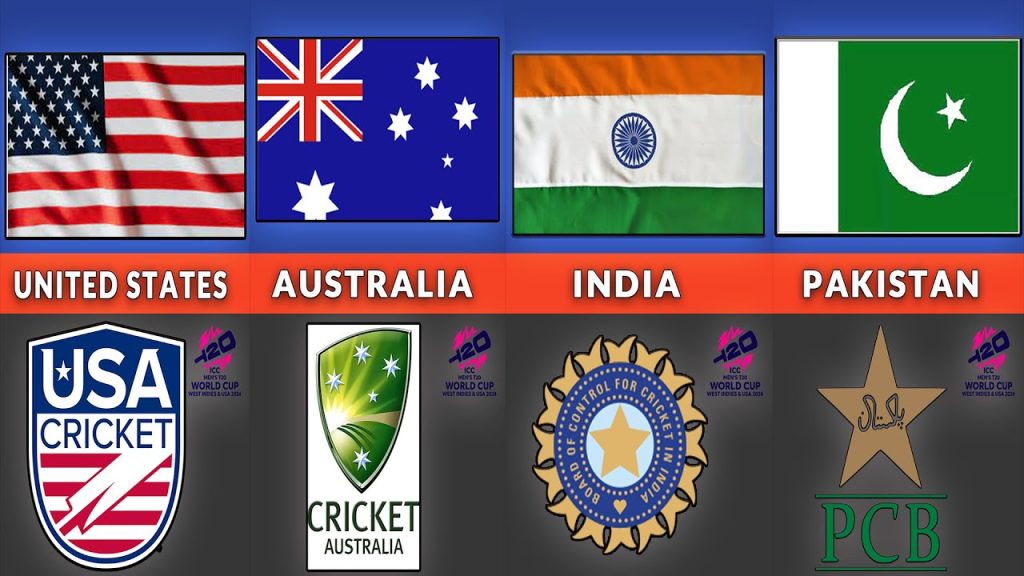
Cricket is one of the world’s most widely played sports, with a growing presence across Asia, Europe, Africa, the Americas and the Pacific. Although countries such as India, Australia and England have long cricketing histories, many emerging nations are now competing in international tournaments.
So, how many countries play cricket in the world?
According to the International Cricket Council (ICC) Development page, there are 111 ICC members as of November 2026, including 12 Full Members and 99 Associate Members.
Mauritius became the ICC’s 111th member on 15 July 2026, following its admission at the ICC Annual Conference in Edinburgh. Although some ICC website pages still display older membership figures, 111 is the current global membership total.
Importantly, ICC membership does not mean that exactly 111 independent countries play cricket. Some members represent multiple territories, while cricket is also played recreationally in countries without ICC membership.
This guide explains how many countries play cricket, the difference between Full and Associate Members, the number of Test, ODI and T20I teams, and how cricket is expanding worldwide.
How Many Countries Play Cricket?
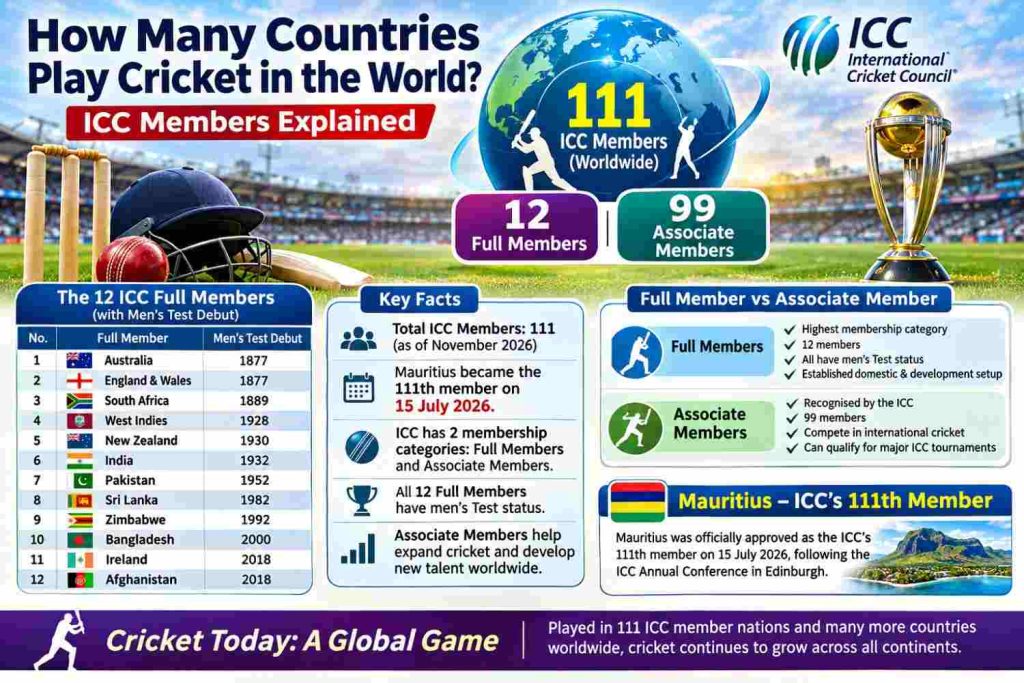
The ICC Development page reports 111 members worldwide, divided into two membership categories: Full Members and Associate Members.
Here is the membership breakdown:
| ICC Membership Category | Number of Members |
| Full Members | 12 |
| Associate Members | 99 |
| Total ICC Members | 111 |
Source: ICC Development page and ICC media release, 15 July 2026.
The ICC’s July 2026 announcement confirmed Mauritius as its 111th member.
It is also important to understand that ICC members are not always independent sovereign countries.
For example, the West Indies cricket team represents several Caribbean countries and territories, while England and Wales share a cricket governing body.
Therefore, the number of ICC members should not be confused with the number of independent countries where cricket is played.
What Is the Difference Between Full Members and Associate Members?
The ICC recognises two main membership categories: Full Members and Associate Members.
These categories reflect differences in membership rights, international cricket status and participation in ICC competitions.
1. Full Members of the ICC
Full Members represent the highest membership category within the ICC.
There are currently 12 Full Members, and all have men’s Test cricket status.
The following table lists the Full Members and the years in which their men’s teams first played Test cricket.
| No. | ICC Full Member | Men’s Test Debut |
| 1 | Australia | 1877 |
| 2 | England & Wales | 1877 |
| 3 | South Africa | 1889 |
| 4 | West Indies | 1928 |
| 5 | New Zealand | 1930 |
| 6 | India | 1932 |
| 7 | Pakistan | 1952 |
| 8 | Sri Lanka | 1982 |
| 9 | Zimbabwe | 1992 |
| 10 | Bangladesh | 2000 |
| 11 | Ireland | 2018 |
| 12 | Afghanistan | 2018 |
Australia and England played the first officially recognised Test match in March 1877 at the Melbourne Cricket Ground.
Ireland and Afghanistan are the newest Full Members. Both received Full Member status in June 2017 and made their men’s Test debuts in 2018.
Full Members generally have established domestic cricket structures, national development programmes and access to major ICC competitions.
2. Associate Members of the ICC
Associate Members are cricket governing bodies recognised by the ICC that do not hold Full Member status.
They play an important role in expanding cricket internationally, developing grassroots programmes and providing opportunities for emerging players.
Examples of Associate cricket nations include:
- Nepal
- Netherlands
- Scotland
- United States
- Canada
- Namibia
- Oman
- United Arab Emirates
- Papua New Guinea
- Italy
- Japan
- Germany
- Mauritius
Associate Members can participate in recognised international cricket and qualify for major ICC tournaments through the relevant qualification pathways.
Several Associate teams, including the Netherlands, Scotland, Nepal and Namibia, have gained international recognition through their performances in ICC competitions.
History of ICC Full and Associate Membership
The ICC’s current two-category membership structure developed through several historical changes.
The first three Associate Members were admitted in July 1965: Ceylon (now Sri Lanka), Fiji and the United States.
Sri Lanka became the first Associate Member to receive Full Member status in July 1981. Its men’s team subsequently made its Test debut in February 1982.
Five of the current 12 Full Members previously held Associate status:
- Sri Lanka
- Zimbabwe
- Bangladesh
- Ireland
- Afghanistan
In June 2017, the ICC abolished Affiliate Membership. All existing Affiliate Members became Associate Members, leaving two main membership categories: Full Members and Associate Members.
New ICC members enter through the Associate Membership category, with the possibility of progressing to Full Membership by meeting the relevant membership criteria.
Zimbabwe also provides an important example of membership suspension. The ICC suspended Zimbabwe Cricket in July 2019 and reinstated it in October 2019, making it the first Full Member to experience such a suspension.
Mauritius Becomes the ICC’s 111th Member
Mauritius was officially approved as the ICC’s 111th member on 15 July 2026.
The decision was announced following the ICC Annual Conference in Edinburgh.
Its admission represents another step in the expansion of organised international cricket, particularly in the African region.
ICC membership creates opportunities for cricket development, international participation and greater recognition of the sport.
What Is Canada’s ICC Membership Status?
Cricket Canada’s membership was suspended by the ICC in June 2026 because of serious breaches of its membership obligations.
On 15 July 2026, the ICC Board approved reinstatement conditions outlining the requirements that Cricket Canada must meet before its membership suspension can be lifted.
Canada’s suspension does not automatically prevent its national teams from participating in ICC events. The ICC confirmed that Canadian national representative teams remain eligible to participate during the suspension.
This distinction is important because a governing body’s suspension does not automatically mean its national teams lose their eligibility for international competitions.
What Is USA Cricket’s ICC Membership Status?
USA Cricket’s ICC membership was suspended on 23 September 2025 because of repeated breaches of its membership obligations.
The ICC cited governance problems, failure to establish a functional governance structure and a lack of progress towards achieving National Governing Body status with the United States Olympic and Paralympic Committee.
Despite the suspension, the United States national teams remain eligible to participate in ICC events, including preparations for the Los Angeles 2028 Olympic Games.
The ICC Normalisation Committee oversees the steps required to restore USA Cricket’s membership rights.
What Is France Cricket’s ICC Membership Status?
Source Image: Itsonlycricket
France Cricket was placed on notice by the ICC at its Annual General Meeting in July 2026 for breaches of the ICC Membership Criteria.
Being placed on notice means the governing body has been formally alerted to membership compliance issues. It is different from an immediate suspension of membership.
How Many Countries Play Test, ODI and T20I Cricket?
Not every ICC member has the same international cricket status.
Test cricket is restricted to Full Members, while ODI cricket includes selected Associate teams. T20 International cricket has a much broader membership-based status system.
Here is the breakdown:
| International Cricket Format | Membership or Status |
| Men’s Test cricket | 12 Full Members |
| Men’s ODI cricket | 20 members |
| Women’s ODI cricket | 16 members |
| Men’s T20 International cricket | All ICC Member men’s teams are eligible for T20I status |
| Women’s T20 International cricket | All ICC Member women’s teams are eligible for T20I status |
These figures describe international status and membership eligibility. They do not necessarily represent the number of teams that have played matches in each format.
Test Cricket
Test cricket is the longest standard format of international cricket.
A Test match is normally scheduled for up to five days, with each team permitted two innings.
Only the 12 ICC Full Members currently hold men’s Test status.
India, Australia, England, South Africa, Pakistan and New Zealand are among the established Test-playing nations.
Ireland and Afghanistan became the newest additions to the men’s Test-playing group in 2018.
Test cricket is traditionally regarded as a major examination of a player’s technique, endurance, concentration and tactical ability.
One Day International Cricket
One Day International cricket, commonly known as ODI cricket, is a limited-overs format.
In a standard men’s ODI match, each team can bat for a maximum of 50 overs.
According to the ICC’s published format information, 20 members hold men’s ODI status.
These include the 12 Full Members and eight Associate teams.
The eight Associate teams with men’s ODI status are:
- Netherlands
- Scotland
- Canada
- Namibia
- Nepal
- Oman
- United Arab Emirates
- United States
These teams participate in recognised ODI competitions and relevant ICC qualification pathways.
Canada and the United States retain their national teams’ eligibility for ICC events despite their respective governing bodies’ membership suspensions.
How Many Countries Play Women’s ODI Cricket?
Women’s ODI cricket has its own international status structure.
The ICC’s published format information identifies 16 members with women’s ODI status.
These consist of 11 Full Members and five Associate Members.
Afghanistan does not have a recognised women’s national cricket team and does not hold women’s ODI status. This is why the number of women’s ODI members is 16 rather than 17.
The five Associate Members with women’s ODI status are:
- Netherlands
- Papua New Guinea
- Scotland
- Thailand
- United States
Women’s ODI matches are generally played with a maximum of 50 overs per side.
The format provides opportunities for established and emerging women’s national teams to compete internationally.
The Women’s Cricket World Cup is one of the leading international tournaments in this format.
Twenty20 International Cricket
Twenty20 International cricket, commonly known as T20I cricket, is a shorter international format.
Each team normally bats for a maximum of 20 overs, and a match typically lasts around three hours.
The ICC introduced universal T20I status for its Member teams to expand international participation.
The policy took effect on the following dates:
| Category | Universal T20I Status Effective |
| ICC Member women’s teams | 1 July 2018 |
| ICC Member men’s teams | 1 January 2019 |
The ICC announced this decision in April 2018.
Under this policy, qualifying matches between ICC Member teams can receive official T20I status without the teams needing Test or ODI status.
However, 111 ICC members should not be interpreted as 111 national teams that have already played men’s T20I matches.
The membership figure describes the ICC’s organisational reach, while actual international participation depends on scheduled and completed matches.
This policy has helped expand international cricket opportunities for emerging nations.
Which ICC Region Has the Most Cricket-Playing Countries?
Cricket is organised across five ICC geographical regions.
These regions are Asia, Europe, Africa, the Americas and East Asia Pacific.
Although Asia includes some of the world’s largest cricket markets, Europe has the highest number of members listed on the ICC’s regional membership pages.
ICC Membership by Region
| ICC Region | Members Listed on Regional Page |
| Europe | 33 |
| Asia | 25 |
| Africa | 21 |
| Americas | 17 |
| East Asia Pacific | 11 |
These figures show the membership counts published on the individual ICC regional pages.
1. Europe
Europe has the highest published regional membership count, with 33 members listed on the ICC Europe page.
England and Ireland are Full Members, while Scotland, Netherlands, Italy and Germany are examples of other cricket-playing nations in the region.
Cricket continues to develop across Europe through national leagues, grassroots programmes and international competitions.
2. Asia
The ICC Asia page lists 25 regional members.
Asia includes major cricket nations such as India, Pakistan, Sri Lanka, Bangladesh and Afghanistan.
Nepal, Oman and the United Arab Emirates are also important participants in international cricket.
Asia is particularly influential because of its large cricket audiences, professional competitions and established cricketing traditions.
3. Africa
The ICC Africa page lists 21 regional members.
South Africa and Zimbabwe are Full Members, while Namibia, Kenya, Uganda and Nigeria contribute to the region’s international cricket development.
Mauritius became the ICC’s 111th member in July 2026, strengthening cricket’s organisational presence in Africa.
Cricket development across the region includes coaching initiatives, youth competitions and national team programmes.
4. Americas
The ICC Americas page lists 17 regional members.
The region includes the West Indies, United States, Canada, Argentina and Brazil.
The West Indies has a long history in international cricket, while the United States has gained increased attention through its involvement in major T20 competitions.
The growth of domestic competitions and international tournaments continues to create opportunities for cricket development across the Americas.
5. East Asia Pacific
The ICC East Asia Pacific page lists 11 regional members.
Australia and New Zealand are established Full Members.
Other cricket-playing nations in the region include Japan, Papua New Guinea, Indonesia and Fiji.
Cricket development initiatives are helping introduce the sport to new communities and younger players.
Why Is Cricket Growing in More Countries?
Cricket’s international expansion is supported by shorter formats, major tournaments, development programmes, women’s cricket and renewed Olympic participation.
1. Growth of T20 Cricket
T20 cricket has played an important role in making the sport accessible to new audiences.
Unlike Test cricket, which can last up to five days, a T20 match usually finishes in approximately three hours.
The shorter format provides opportunities for new viewers, broadcasters, sponsors and players to engage with the sport.
It is also easier to schedule in multi-team international tournaments.
2. International Cricket Tournaments
ICC tournaments allow emerging cricket nations to compete against established teams.
The Men’s T20 World Cup and Women’s T20 World Cup are important platforms for increasing international exposure.
Associate teams can also participate in qualification competitions, providing opportunities to progress towards major global events.
These competitions help developing teams gain experience and strengthen their cricket programmes.
3. ICC Development Programmes
The ICC supports cricket development through funding, coaching, administration, education and grassroots initiatives.
According to the ICC Development page, more than 1.5 million people participate in cricket outside Full Member nations.
This ICC-reported figure highlights the importance of cricket participation beyond traditionally established cricket markets.
Development programmes can help national governing bodies improve coaching standards, organise competitions and create opportunities for young players.
4. Expansion of Women’s Cricket
Women’s cricket is an important part of the sport’s international growth.
More cricket governing bodies are developing women’s national teams, domestic competitions and participation programmes.
The ICC’s universal women’s T20I status policy has also created opportunities for emerging teams to compete in officially recognised international matches.
Major tournaments, including the Women’s Cricket World Cup and Women’s T20 World Cup, provide international exposure and encourage wider participation.
5. Cricket’s Return to the Olympics
Cricket is scheduled to return to the Olympic Games at Los Angeles 2028 after an absence of 128 years.
The sport previously appeared at the Paris 1900 Olympics.
At LA28, cricket will be played in the T20 format, with six men’s teams and six women’s teams participating.
The Olympic return could introduce cricket to new audiences and encourage greater investment in the sport.
It also provides another opportunity to increase international interest in cricket beyond its traditional markets.
Is Cricket Played in Countries That Are Not ICC Members?
Yes. Cricket is played in places beyond the ICC membership structure.
Some countries have recreational cricket clubs, local leagues, amateur competitions and expatriate cricket communities without having an ICC-recognised national governing body.
Therefore, there is no single universally accepted figure covering every country where cricket is played.
Cricket’s global reach can be measured in three different ways:
ICC membership: Cricket governing bodies officially recognised by the International Cricket Council.
International participation: National or representative teams competing in officially recognised international matches.
Grassroots participation: People playing cricket through clubs, schools, local leagues and recreational activities.
These categories measure different aspects of cricket participation.
The ICC membership total is the clearest official benchmark for the sport’s organised international structure, but it does not capture every country where people play cricket.
Conclusion:
Cricket has developed into an international sport with organised participation across five ICC regions.
According to the ICC Development page, there are 111 ICC members as of November 2026, including 12 Full Members and 99 Associate Members. Mauritius became the ICC’s 111th member on 15 July 2026.
The 12 Full Members have men’s Test status, while 20 members hold men’s ODI status. The ICC’s universal T20I policy also extends international status opportunities across its membership.
From established cricket nations such as India, Australia and England to emerging teams such as Nepal, Oman, Japan and Mauritius, cricket continues to expand into new markets.
However, ICC membership does not represent every independent country where cricket is played. Recreational and domestic cricket also exists beyond the ICC system.
Cricket’s future growth will depend on international opportunities, grassroots participation, women’s cricket development and continued investment in emerging cricket nations.
Frequently Asked Questions (FAQs)
The ICC Development page reports 111 members as of November 2026, including 12 Full Members and 99 Associate Members. However, these are ICC members rather than necessarily 111 independent countries. Cricket is also played recreationally outside the ICC membership system
There are 12 men’s Test-playing Full Members: Australia, England, South Africa, West Indies, New Zealand, India, Pakistan, Sri Lanka, Zimbabwe, Bangladesh, Ireland and Afghanistan.
According to the ICC’s published format information, 20 members hold men’s ODI status. These include 12 Full Members and eight Associate teams: Netherlands, Scotland, Canada, Namibia, Nepal, Oman, United Arab Emirates and United States.
The ICC’s published format information identifies 16 members with women’s ODI status. These consist of 11 Full Members and five Associate Members. Afghanistan does not have a recognised women’s national cricket team and does not hold women’s ODI status.
Mauritius became the ICC’s 111th member on 15 July 2026, following its admission at the ICC Annual Conference in Edinburgh.