
Cricket stadiums in India differ in boundary dimensions, playing areas and ground layouts. Some have shorter boundaries that favour batters, while others offer larger playing areas that require greater power and accurate shot placement.
When comparing India’s biggest cricket stadiums, it is important to distinguish between the longest individual boundary and the overall playing area, as both measurements can produce different rankings.
According to The Cricket Boundary’s database, Ekana Cricket Stadium has the largest calculated playing-area estimate among 22 Indian grounds, although its listed 76-metre square boundary is disputed. VCA Stadium in Nagpur also ranks among the largest, with dimensions of 71 metres straight and 77 metres square, closely matching independently reported figures of approximately 73.2 metres and 77.7 metres, respectively.
Biggest Cricket Stadiums in India by Boundary Size and Playing Area
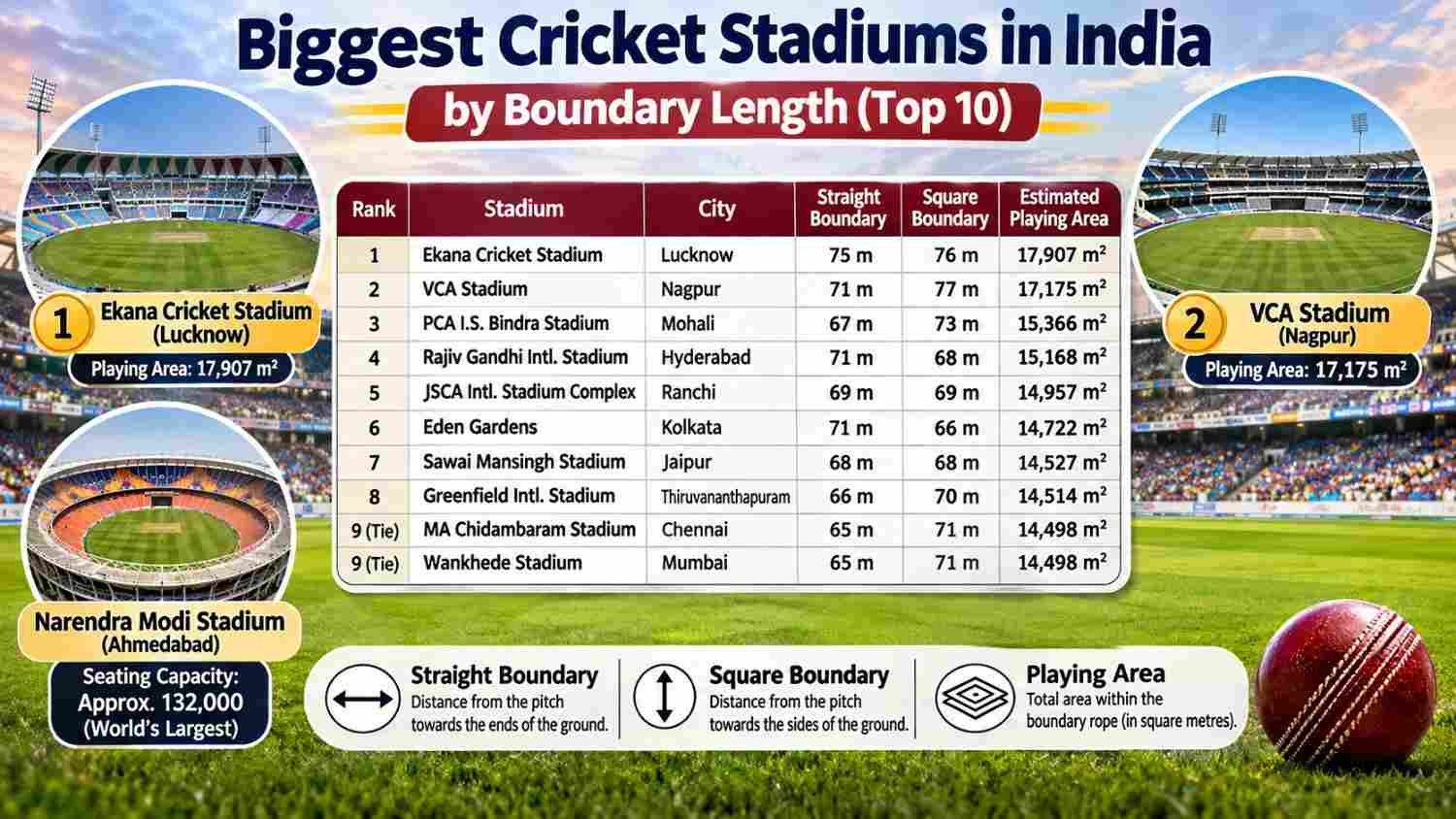
The Cricket Boundary database gives Ekana Cricket Stadium the largest estimated playing area among its 22 listed Indian grounds. Its calculation uses dimensions of 75 metres straight and 76 metres square.
However, other published reports give Ekana shorter square-boundary measurements. The 76-metre figure is therefore not independently confirmed.
VCA Stadium in Nagpur has a listed square boundary of 77 metres. Other venue descriptions report approximately 80 yards straight and 85 yards square, equivalent to around 73.2 metres and 77.7 metres. These figures are close to the database measurements and provide stronger external support for VCA’s large playing area.
For this comparison, VCA is presented as the more strongly corroborated candidate, while Ekana retains the largest database-only area estimate. The positions should not be read as a certified national ranking because the available measurements do not all come from the same method.
The following table compares the ten grounds using the figures listed in The Cricket Boundary database.
| Position | Stadium | City | Straight Boundary | Square Boundary | Estimated Playing Area |
| 1* | VCA Stadium | Nagpur | 71 m | 77 m | 17,175 m² |
| 2* | Ekana Cricket Stadium | Lucknow | 75 m | 76 m | 17,907 m² |
| 3 | PCA I.S. Bindra Stadium | Mohali | 67 m | 73 m | 15,366 m² |
| 4 | Rajiv Gandhi International Cricket Stadium | Hyderabad | 71 m | 68 m | 15,168 m² |
| 5 | JSCA International Stadium Complex | Ranchi | 69 m | 69 m | 14,957 m² |
| 6 | Eden Gardens | Kolkata | 71 m | 66 m | 14,722 m² |
| 7 | Sawai Mansingh Stadium | Jaipur | 68 m | 68 m | 14,527 m² |
| 8 | Greenfield International Stadium | Thiruvananthapuram | 66 m | 70 m | 14,514 m² |
| 9 (Tie) | MA Chidambaram Stadium | Chennai | 65 m | 71 m | 14,498 m² |
| 9 (Tie) | Wankhede Stadium | Mumbai | 65 m | 71 m | 14,498 m² |
VCA is placed first as the more strongly corroborated candidate based on the available independent venue dimensions. Ekana has a higher calculated area in The Cricket Boundary database, but its 76-metre square-boundary figure is disputed. The table is an evidence-led comparison, not a certified measurement ranking.
How Is Estimated Playing Area Calculated?
The database uses the formula:
Estimated playing area = π × straight boundary × square boundary
This treats the playing area as an ellipse, using the straight and square measurements as its two radii.
For example, Ekana’s listed dimensions produce:
π × 75 × 76 = approximately 17,907 m².
For VCA Stadium:
π × 71 × 77 = approximately 17,175 m².
The same calculation is applied to the other grounds:
| Stadium | Calculation | Estimated Area |
| PCA I.S. Bindra Stadium | π × 67 × 73 | 15,366 m² |
| Rajiv Gandhi International Cricket Stadium | π × 71 × 68 | 15,168 m² |
| JSCA International Stadium Complex | π × 69 × 69 | 14,957 m² |
| Eden Gardens | π × 71 × 66 | 14,722 m² |
| Sawai Mansingh Stadium | π × 68 × 68 | 14,527 m² |
| Greenfield International Stadium | π × 66 × 70 | 14,514 m² |
| MA Chidambaram Stadium | π × 65 × 71 | 14,498 m² |
| Wankhede Stadium | π × 65 × 71 | 14,498 m² |
The formula explains why MA Chidambaram Stadium and Wankhede Stadium have exactly the same estimated playing area. Both have identical listed straight and square measurements.
Important measurement note: The database combines satellite-measured dimensions and figures published by other sources. Eighteen of the 22 grounds are satellite-measured, while four use published measurements. These methods may measure different edges of the playing area. Therefore, this is a database-based comparison rather than an official, independently certified ranking of all Indian cricket grounds.
Satellite measurement estimates have an approximate accuracy of ±2 metres. That tolerance does not resolve larger disagreements between different sources, particularly where Ekana’s square-boundary figure is concerned.
Top 10 Biggest Cricket Stadiums in India by Playing Area
1. VCA Stadium, Nagpur
Straight boundary: 71 metres
Square boundary: 77 metres
Estimated playing area: 17,175 square metres
Location: Nagpur, Maharashtra
The Vidarbha Cricket Association Stadium, commonly known as VCA Stadium, is located in Jamtha, Nagpur.
The Cricket Boundary database lists its straight boundary at 71 metres and its square boundary at 77 metres. The square measurement is the longest among the 22 Indian grounds in that database.
VCA’s dimensions also have independent support. Other venue descriptions give its straight boundaries as 80 yards and square boundaries as 85 yards, equivalent to approximately 73.2 metres and 77.7 metres respectively. These figures are close to the database measurements and provide stronger external corroboration than is available for Ekana’s 76-metre square figure.
The difference between its straight and square measurements creates different challenges for batters depending on their shot selection. Players attempting to clear the boundary with square cuts, pulls and other horizontal-bat shots may need additional power.
The stadium hosted its first international Test match in 2008 and has also hosted international limited-overs matches and IPL fixtures.
Its estimated playing area of 17,175 square metres makes it one of the largest grounds in the database comparison. Its dimensions also have stronger independent support than Ekana’s disputed square-boundary figure.
2. Ekana Cricket Stadium, Lucknow
Straight boundary: 75 metres
Square boundary: 76 metres (database figure)
Estimated playing area: 17,907 square metres
Location: Lucknow, Uttar Pradesh
Ekana Cricket Stadium, officially known as Bharat Ratna Shri Atal Bihari Vajpayee Ekana Cricket Stadium, has the largest calculated playing-area estimate among the 22 Indian grounds included in The Cricket Boundary database.
Its listed straight boundary measures 75 metres, while its square boundary is listed at 76 metres. However, other published reports give shorter square-boundary figures, generally in the region of 63–70 metres. The 76-metre figure should therefore be treated as a database-specific measurement rather than a universally confirmed ground dimension.
The venue opened in 2017 and has a seating capacity of approximately 50,000. It hosts international cricket matches and is the home ground of Lucknow Super Giants in the Indian Premier League.
Ekana Stadium’s Development and Background
Ekana Stadium was developed under a public-private partnership between Ekana Sportz City and the Lucknow Development Authority.
Reports on the project describe a 35-year lease arrangement involving approximately 71 acres for the sports infrastructure. A further 66 acres were provided for commercial and real estate development under a 99-year lease. The cricket stadium’s construction budget was reported at approximately ₹360 crore.
The wider development was planned as a sports and commercial project rather than only a cricket venue. This included sports facilities alongside residential and commercial development.
T20 Scoring at Ekana Stadium
Boundary size is only one factor affecting scores at a cricket ground. Pitch behaviour, weather, match format and the position of the boundary rope also influence batting conditions.
Published venue statistics show that the average first-innings score at Ekana changes depending on the format and matches included. One dataset reported an average of approximately 162 in men’s T20 Internationals across seven matches through October 2026. Another dataset reported an average of approximately 170.9 across completed T20 first innings from 2021 to May 2026.
These figures should not be combined because they cover different match samples and formats. They do show why a single average score should not be presented as a permanent measure of the ground.
A first-innings total around 160 can be competitive in some T20I conditions, but it should not automatically be described as a winning score. The result depends on the pitch, opposition, weather and match situation.
A longer boundary can make six-hitting more demanding, but it does not by itself guarantee a low-scoring match.
3. PCA I.S. Bindra Stadium, Mohali
Straight boundary: 67 metres
Square boundary: 73 metres
Estimated playing area: 15,366 square metres
Location: Mohali, Punjab
PCA I.S. Bindra Stadium, formerly commonly known as PCA Stadium, is an important cricket venue in Mohali, Punjab.
The ground has a listed straight boundary of 67 metres and a square boundary of 73 metres. Its square dimensions are noticeably longer than its straight dimensions.
This difference can influence batting strategies because the distance required to clear the boundary varies depending on the direction of the shot.
The stadium has hosted several international cricket matches, including Test matches, One Day Internationals and T20 Internationals. It is also an important venue for domestic cricket in Punjab.
With an estimated playing area of 15,366 square metres, it occupies a prominent position in the database’s listed playing-area comparison.
4. Rajiv Gandhi International Cricket Stadium, Hyderabad
Straight boundary: 71 metres
Square boundary: 68 metres
Estimated playing area: 15,168 square metres
Location: Hyderabad, Telangana
Rajiv Gandhi International Cricket Stadium is one of India’s prominent international cricket venues. Located in Uppal, Hyderabad, the stadium serves as the home ground of Sunrisers Hyderabad in the Indian Premier League.
According to The Cricket Boundary database, its straight boundary measures 71 metres, while its square boundary measures 68 metres.
The longer straight measurement can make straight lofted shots more challenging than at venues with shorter straight boundaries.
The stadium regularly hosts international cricket matches, IPL fixtures and other major domestic competitions.
Its estimated playing area of 15,168 square metres places it among the larger grounds in this database comparison.
5. JSCA International Stadium Complex, Ranchi
Straight boundary: 69 metres
Square boundary: 69 metres
Estimated playing area: 14,957 square metres
Location: Ranchi, Jharkhand
The JSCA International Stadium Complex is one of India’s important cricket venues in eastern India. Located in Ranchi, Jharkhand, it has hosted international matches and Indian Premier League fixtures.
Its listed straight and square boundary measurements are both 69 metres.
This balanced configuration means that the listed distances are similar in the straight and square directions.
The stadium has hosted international Test matches, One Day Internationals and T20 Internationals. It has also served as an IPL venue.
With an estimated playing area of 14,957 square metres, JSCA International Stadium ranks among the larger grounds in the database’s listed comparison.
6. Eden Gardens, Kolkata
Straight boundary: 71 metres
Square boundary: 66 metres
Estimated playing area: 14,722 square metres
Location: Kolkata, West Bengal
Eden Gardens is one of the oldest and most historic cricket stadiums in India. Established in 1864, it is located in Kolkata, West Bengal.
The Cricket Boundary database lists its straight boundary at 71 metres and its square boundary at 66 metres.
These figures are published measurements rather than satellite measurements in the database. They should therefore not be treated as directly equivalent to every satellite-measured figure in the comparison.
Eden Gardens has hosted numerous memorable international cricket matches and major tournaments. It is also the home ground of Kolkata Knight Riders in the Indian Premier League.
Known for its passionate cricket supporters and rich history, Eden Gardens remains one of India’s most recognised cricket venues.
Its listed estimated playing area is 14,722 square metres.
7. Sawai Mansingh Stadium, Jaipur
Straight boundary: 68 metres
Square boundary: 68 metres
Estimated playing area: 14,527 square metres
Location: Jaipur, Rajasthan
Sawai Mansingh Stadium is an important cricket venue located in Jaipur, Rajasthan. It is the home ground of Rajasthan Royals in the Indian Premier League.
According to The Cricket Boundary database, both its straight and square boundaries measure 68 metres.
The equal measurements provide similar listed distances in both directions of the ground.
The stadium has hosted international cricket matches, including Test matches, One Day Internationals and T20 Internationals.
It is also regularly used for domestic cricket and IPL fixtures.
Its estimated playing area of 14,527 square metres places it among the larger grounds in the database’s listed comparison.
8. Greenfield International Stadium, Thiruvananthapuram
Straight boundary: 66 metres
Square boundary: 70 metres
Estimated playing area: 14,514 square metres
Location: Thiruvananthapuram, Kerala
Greenfield International Stadium, located in Thiruvananthapuram, Kerala, is one of India’s modern international cricket venues.
The database lists its straight boundary at 66 metres and its square boundary at 70 metres.
Its square boundary is four metres longer than its straight boundary, creating different distances for batters attempting to hit sixes in different directions.
The stadium has hosted international cricket matches and major sporting events.
Its estimated playing area is 14,514 square metres, placing it eighth among the listed Indian grounds in this comparison.
9 (Tie). MA Chidambaram Stadium, Chennai
Straight boundary: 65 metres
Square boundary: 71 metres
Estimated playing area: 14,498 square metres
Location: Chennai, Tamil Nadu
MA Chidambaram Stadium, popularly known as Chepauk, is one of India’s oldest international cricket venues. Established in 1916, it is located in Chennai, Tamil Nadu.
The database lists its straight boundary at 65 metres and its square boundary at 71 metres.
The difference between these measurements means that the straight and square boundaries offer different distances for batters attempting to clear the rope.
The stadium is the home ground of Chennai Super Kings in the Indian Premier League. It has hosted several memorable international matches and major domestic competitions.
Its estimated playing area is 14,498 square metres.
9 (Tie). Wankhede Stadium, Mumbai
Straight boundary: 65 metres
Square boundary: 71 metres
Estimated playing area: 14,498 square metres
Location: Mumbai, Maharashtra
Wankhede Stadium is one of India’s best-known international cricket grounds. Located in Mumbai, Maharashtra, it has hosted several important international tournaments and matches.
The Cricket Boundary database lists its straight boundary at 65 metres and its square boundary at 71 metres.
These are published measurements rather than satellite measurements in the database.
Wankhede Stadium hosted the final of the 2011 ICC Cricket World Cup, where India defeated Sri Lanka to win the tournament.
The stadium is also the home ground of Mumbai Indians in the Indian Premier League.
Its listed estimated playing area is 14,498 square metres, exactly the same as MA Chidambaram Stadium. Therefore, both grounds share ninth position in this comparison.
Narendra Modi Stadium: Is It India’s Biggest Cricket Stadium by Boundary?
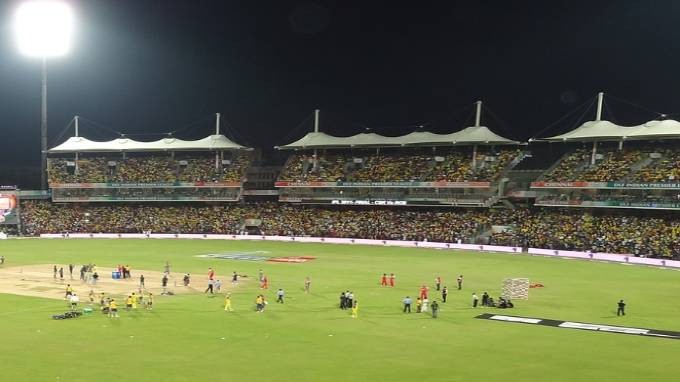
Source Image : 99acres
Narendra Modi Stadium in Ahmedabad, Gujarat, is the world’s largest cricket stadium by seating capacity, with approximately 132,000 spectators.
However, seating capacity and playing-area dimensions are two different measurements. A stadium can accommodate more spectators without having the longest cricket boundaries.
According to The Cricket Boundary database, Narendra Modi Stadium has the following listed dimensions:
| Measurement | Database Figure |
| Straight boundary | 66 metres |
| Square boundary | 68.5 metres |
| Estimated playing area | 14,203 m² |
| Seating capacity | Approximately 132,000 |
These are published boundary figures in the database rather than satellite measurements.
Match-day boundary measurements can be different. For example, a February 2026 match report used figures of approximately 70 metres straight and 60 metres and 68 metres on the square sides. This does not automatically mean that either set of figures is incorrect: the rope position and the pitch selected for a match can change the measured distances.
The same distinction applies to Ekana and other grounds. A database measurement describes a reference layout, while a match report may describe the actual boundary configuration used for a particular fixture.
For a separate discussion of Narendra Modi Stadium’s match-specific boundary measurements, see our article on Narendra Modi Stadium’s boundary length. The related article should also link back to this comparison so readers can move between the two discussions.
Narendra Modi Stadium remains the world’s largest cricket stadium by seating capacity, but its listed playing-area estimate is below the estimates for Ekana and VCA in The Cricket Boundary comparison.
How Are Cricket Boundary Lengths Measured?
Cricket boundary measurements describe the distances from the centre of the pitch being used to different parts of the playing area’s boundary.
Two commonly reported measurements are straight boundary distance and square boundary distance.
1. Straight Boundary
The straight boundary measures the distance from the pitch towards the boundary behind the bowler or batter.
It is relevant when batters attempt straight drives, lofted shots and other hits towards the ends of the ground.
In The Cricket Boundary’s measurement methodology, the straight measurement is calculated by averaging the distances behind the bowler at the two opposite ends of the pitch.
2. Square Boundary
The square boundary measures the distance from the pitch towards the boundary on either side of the playing area.
It is relevant for shots such as pulls, cuts and other horizontal-bat strokes.
The database calculates the square measurement by averaging the distances on either side of the pitch.
3. Satellite-Based Measurements
Satellite-based measurements use the pitch centre and four boundary points to estimate the dimensions of a cricket ground.
The measurements are averaged to provide straight and square distances.
The Cricket Boundary database estimates the accuracy of its satellite measurements at approximately ±2 metres.
However, not every ground in its Indian database uses this method. Some stadiums use published measurements from other sources.
4. Why Do Boundary Distances Change Between Matches?
Boundary distances do not necessarily remain identical for every cricket match at a stadium.
The boundary rope can be positioned differently depending on the ground layout, pitch being used and applicable playing conditions.
For example, Narendra Modi Stadium’s database reference measurements are 66 metres straight and 68.5 metres square, while a February 2026 match report used a different set of match-day measurements. The two sets of figures describe different measurement contexts.
As a result, a stadium’s published or satellite-measured dimensions should be treated as reference figures rather than guaranteed measurements for every match.
What Are the ICC Rules for Cricket Boundary Distances?
The International Cricket Council’s international playing conditions specify requirements for boundary distances.
Under the boundary provisions in ICC international playing conditions:
- The boundary should generally be at least 65 yards (59.43 metres) from the centre of the pitch being used.
- No boundary should be longer than 90 yards (82.29 metres).
- A minimum three-yard (2.74-metre) safety area must be maintained between the boundary rope and the first solid object.
- A previously approved international ground that cannot meet the minimum boundary dimension may qualify for an exemption under Clause 19.1.6 of the cited playing conditions.
The minimum and maximum boundary provisions appear under Clause 19.1.3. The three-yard player safety run-off is covered by Clause 19.1.4, while the exemption for previously approved grounds is covered by Clause 19.1.6. Boundary identification and marking are addressed separately under Clause 19.2.
These requirements help maintain consistency and provide appropriate playing conditions across international cricket venues.
The boundary position is fixed for the duration of an individual match, although it can differ between separate matches at the same stadium.
Which Indian Cricket Stadium Has the Largest Playing Area?
The answer depends on which measurement and source are used.
The Cricket Boundary database gives Ekana Cricket Stadium in Lucknow the largest calculated playing-area estimate among its 22 listed Indian grounds, at 17,907 square metres. However, its 76-metre square-boundary figure is disputed by other published reports. The database estimate should not be treated as an independently confirmed national record.
VCA Stadium in Nagpur has a database estimate of 17,175 square metres and a listed square boundary of 77 metres. Independent venue descriptions also report approximately 80-yard straight and 85-yard square boundaries. These figures provide stronger support for VCA as one of India’s largest grounds by field area.
The longest individual boundary and the largest playing area are not the same thing. VCA has the longest listed square boundary in The Cricket Boundary database, while Ekana has the highest calculated playing-area estimate in that database.
It is also important to remember that the database combines satellite measurements with published figures. Its playing-area comparison should therefore be understood as a reference dataset, not an official measurement-based ranking of every Indian stadium.
Conclusion
India has several cricket grounds with large playing areas and long boundaries. However, the biggest ground depends on the measurement used and the reliability of the available figures.
The Cricket Boundary database ranks Ekana Cricket Stadium highest by estimated playing area at 17,907 square metres, although its 76-metre square-boundary figure is disputed. VCA Stadium in Nagpur has an estimated area of 17,175 square metres and a 77-metre square boundary, supported by independent venue reports.
Meanwhile, Narendra Modi Stadium in Ahmedabad is the world’s largest cricket stadium by seating capacity, with approximately 132,000 seats. Accurate comparisons should consider boundary distances, estimated playing area and match-specific rope positions.
Frequently Asked Questions
The Cricket Boundary database gives Ekana Cricket Stadium in Lucknow the highest estimated playing area, at 17,907 square metres. However, its 76-metre square-boundary figure is disputed. VCA Stadium in Nagpur has stronger independent support for its large field dimensions.
VCA Stadium in Nagpur has the longest listed square boundary among the 22 grounds in The Cricket Boundary database, measuring 77 metres.
Narendra Modi Stadium is the world’s largest cricket stadium by seating capacity, with approximately 132,000 seats. However, it does not have the largest listed playing-area estimate or longest listed square boundary in The Cricket Boundary’s Indian ground comparison.
The Cricket Boundary database estimates playing area using the formula π × straight boundary × square boundary. For example, its Ekana figures produce π × 75 × 76, or approximately 17,907 square metres.
No. Boundary rope positions can vary between matches depending on the ground layout, pitch position and applicable playing conditions. Published and satellite-measured dimensions should therefore be treated as reference figures rather than fixed measurements for every fixture.