
Cricket does not have a single known inventor. It developed gradually over several centuries in England, with its earliest possible origins dating back to Saxon or Norman times. The earliest definite documentary evidence comes from a 1598 legal record in Guildford, Surrey, referring to a game played around 1550.
Although no individual invented cricket, England played the central role in developing its rules, organising competitions and spreading the sport internationally. Today, cricket is played and followed across countries including India, Australia, England, South Africa and the West Indies.
Who Invented Cricket? The Historical Answer
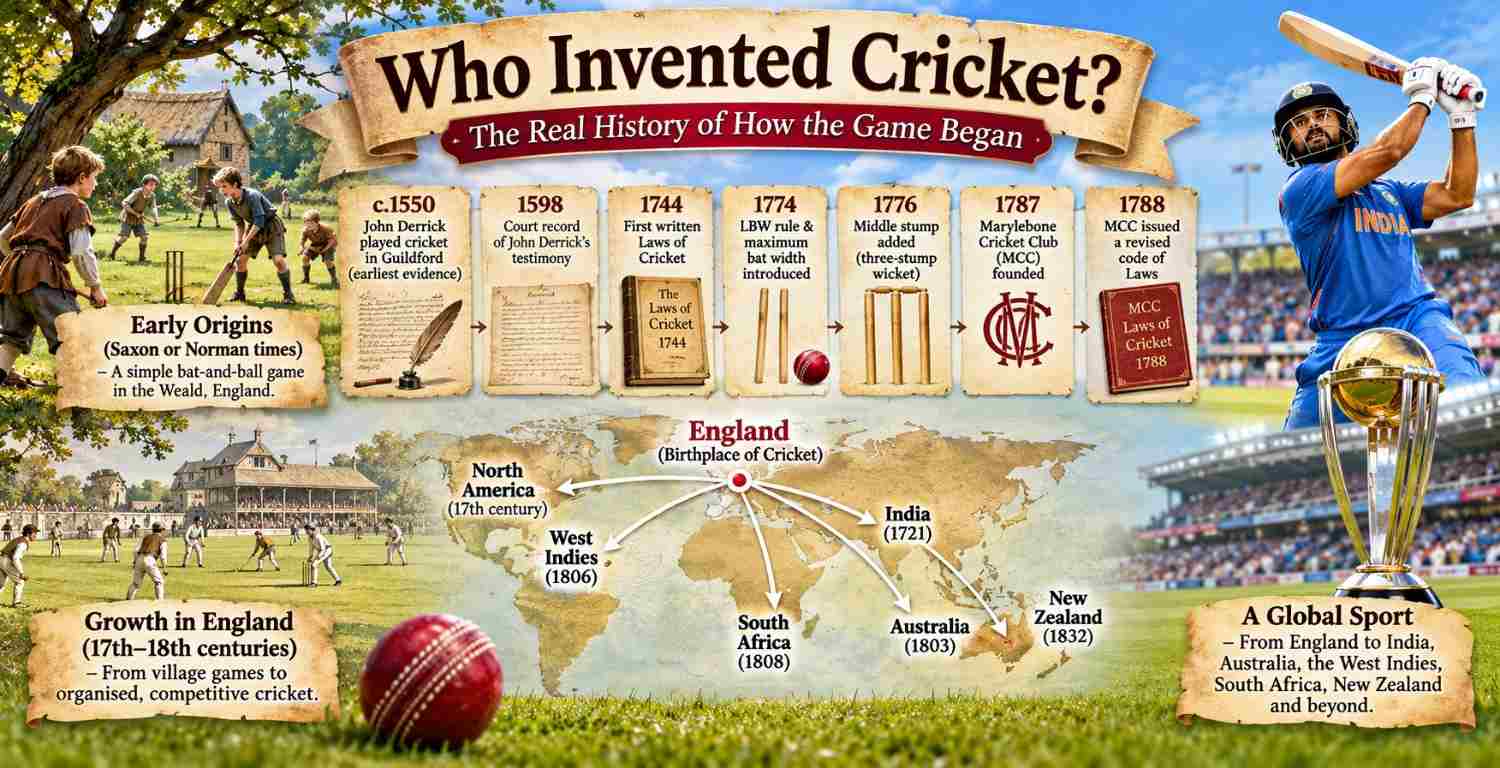
No individual is officially recognised as the inventor of cricket. Historical research suggests that the sport developed gradually in south-east England, particularly in an area known as the Weald.
According to the International Cricket Council (ICC), a widely accepted historical theory suggests that cricket may have originated during Saxon or Norman times. Children living in the Weald, a woodland region in south-east England, are believed to have played an early form of the game in woodland clearings.
These early games were very different from modern cricket. Players probably used simple wooden sticks as bats and improvised objects as balls. The game may also have developed from older bat-and-ball activities, including bowls.
However, historians cannot establish the exact year cricket began or identify the first person who played it. There is no definitive historical evidence proving when or how the game originated.
Therefore, cricket should be understood as a sport that evolved over time rather than one invented by a particular individual.
Where Did Cricket Originate?
Cricket originated in England, with its earliest known development associated with south-eastern counties, particularly Kent, Sussex and Surrey.
The Weald is an important part of cricket’s early history. It was a largely rural and wooded region with open spaces and small settlements. These surroundings provided opportunities for children to play simple outdoor games.
One historical theory suggests that cricket developed from an activity in which players bowled an object towards a target while another player attempted to stop it using a stick. Over time, this activity may have evolved into a more organised bat-and-ball game.
However, the exact connection between these early activities and modern cricket remains uncertain.
Historians distinguish between possible origins and reliable written evidence. While cricket may have existed during the medieval period, its earliest definite documentary reference comes from the 16th century.
The important point: England is widely recognised as the birthplace of cricket, but the identity of its original inventor remains unknown.
When Was Cricket First Played?
Cricket probably existed long before it appeared in historical documents. One of the most important pieces of evidence comes from a legal case in Guildford, Surrey.
In 1598, a man named John Derrick gave evidence during a dispute over a piece of land. He recalled playing a game called creckett with other schoolboys approximately 50 years earlier.
His testimony suggests that children were playing cricket in Guildford around 1550.
This makes the Guildford record particularly important because it provides the earliest definite documentary evidence of cricket.
The distinction between these two dates matters:
- Around 1550: The approximate period when John Derrick and his school friends played cricket.
- 1598: The year when the court record documented his testimony.
Another important reference appeared in 1611 in Sussex. Two men were prosecuted for playing cricket on a Sunday instead of attending church. This record is significant because it provides evidence of adults playing cricket, showing that the game had moved beyond children’s recreation.
The 1598 reference is generally treated as the earliest definite documentary evidence of cricket. However, it does not prove that cricket was invented in that year.
How Did Early Cricket Look?
Early cricket was considerably different from the sport played today. The equipment, bowling techniques, wickets and playing conditions gradually changed as the game became more popular.
Some important characteristics of early cricket included:
1. Curved Wooden Bats
Historical illustrations show that early cricket bats were curved and resembled hockey sticks. This design was suitable when bowlers rolled the ball along the ground.
As bowling techniques changed, players gradually adopted straighter bats to defend their wickets and hit pitched deliveries more effectively.
2. Underarm Bowling
Early bowling involved rolling or delivering the ball along the ground towards the batsman.
Around the 1760s, bowlers increasingly began pitching the ball rather than simply rolling it. This development influenced batting techniques and contributed to the transition towards the modern straight bat.
3. Simple Wickets and the Introduction of the Third Stump
Early cricket used simpler wicket arrangements than the modern three-stump structure. Historical accounts describe an arrangement involving two stumps and a single bail.
An important incident took place on 23 May 1775 at the Artillery Ground. The bowler Lumpy Stevens beat John Small three times with deliveries that passed cleanly between the two stumps without dislodging the bail. Small survived those deliveries and went on to score runs.
Partly as a result of this incident, a third stump was agreed upon to close the gap between the two existing stumps.
The change was not adopted everywhere immediately. The introduction of the third stump was gradual, and two-stump wickets continued to be used for a number of years. The first recorded match known to have used three stumps took place on 6 September 1776 between Chertsey and Coulsdon.
This development eventually helped create the familiar three-stump wicket used in modern cricket.
4. Limited Protective Equipment
Early cricketers did not have the modern protective equipment used by professional players today.
Batting and bowling involved different challenges because the ball was initially rolled along the ground. Protective equipment gradually developed as the game became faster and more competitive.
These changes helped transform cricket from a simple outdoor activity into a more technically demanding sport.
How Did Cricket Become an Organised Sport?
Cricket gradually moved from village entertainment to organised competition. During the 17th century, the game became increasingly popular among adults.
By the middle of the 17th century, village cricket was well established. Local players began earning money by participating in matches, creating an early form of professional cricket.
The popularity of the sport continued to increase during the 18th century. Wealthy individuals and members of the English aristocracy supported teams, organised matches and helped develop competitive cricket.
Several important developments helped cricket become a recognised sport.
The Rise of County Cricket
By 1709, there was a documented cricket match involving teams identified by county names.
This was an important development because cricket was moving beyond informal village games towards organised regional competition.
The Hambledon Club in Hampshire subsequently became one of the most influential centres of cricket during the 18th century. Its earliest surviving record dates from 1756, and it helped establish the sport’s reputation through competitive matches and talented players.
The 1727 Articles of Agreement
Before cricket had a generally accepted written code, individual matches were sometimes governed by specific agreements.
In 1727, the Duke of Richmond and Alan Brodrick drew up Articles of Agreement to establish the terms for wagered cricket matches. These agreements helped settle the conditions under which the matches would be played.
Gambling and wagers were important influences on the organisation of early cricket. As money was increasingly involved in competitive matches, players and organisers needed clear rules to settle disputes and ensure that everyone followed the same conditions.
These match-specific agreements helped pave the way for the more comprehensive written Laws of Cricket established in 1744.
The First Written Laws of Cricket in 1744
As cricket became more competitive, players needed agreed rules to settle disagreements and maintain consistency during matches.
In 1744, the first generally accepted written Laws of Cricket were established by members associated with the Star and Garter Club.
These laws covered important aspects of the game, including wickets, dismissals, umpires and playing conditions.
The 1727 Articles of Agreement were among the earlier match-specific arrangements that preceded the 1744 code. The written Laws of 1744 became an important milestone in cricket’s formal development.
Important Rule Changes in 1774 and 1776
Cricket’s rules continued to develop as the sport became more organised.
An incident in 1771 helped bring about an important change to the Laws. Thomas White of Chertsey arrived for a match against Hambledon with a bat as wide as the wicket. Known as the Monster Bat Incident, it exposed the need to limit bat width so that a batter could not block the entire wicket.
The 1774 revision of the Laws of Cricket introduced a maximum bat width of 4¼ inches. The same revision also fixed the ball’s weight at 5.5 to 5.75 ounces. These restrictions remain part of cricket’s historical equipment specifications.
The 1774 revision also introduced the leg before wicket (LBW) rule.
The third stump followed a different timeline. After Lumpy Stevens beat John Small three times through the two-stump wicket in May 1775, a third stump was agreed upon. Its adoption was gradual, and the first recorded match using three stumps took place in September 1776.
These developments helped make the game more structured and consistent.
The Formation of MCC in 1787
The Marylebone Cricket Club (MCC) was founded in 1787 in London.
It became the principal custodian of the Laws of Cricket and played a major role in establishing consistent playing rules.
In 1788, MCC issued a revised code of cricket laws. The organisation continues to serve as the guardian of the Laws of Cricket.
The establishment of MCC was an important milestone in the development of modern cricket because it helped standardise the sport’s rules.
Who Helped Shape Modern Cricket?
Although cricket has no known individual inventor, several people and institutions played important roles in its development.
| Person or Institution | Contribution to Cricket |
| John Derrick | Provided important evidence of cricket being played around 1550. |
| Hambledon Club | Helped establish cricket as a major competitive sport during the 18th century. |
| Thomas Lord | Established the original Lord’s cricket ground in 1787. |
| Marylebone Cricket Club (MCC) | Helped standardise and administer the Laws of Cricket. |
| International Cricket Council (ICC) | Developed into the international governing body for cricket. |
The Hambledon Club in Hampshire became a major centre of cricket during the 18th century. Its influence attracted talented players and helped establish the sport’s reputation.
Thomas Lord also played an important role in cricket history. He established his original cricket ground in London in 1787. The ground later moved to different locations, with the present Lord’s Cricket Ground in St John’s Wood opening in 1814.
Today, Lord’s is one of the most recognised cricket venues in the world.
The Marylebone Cricket Club was founded in 1787 and became an important institution in cricket’s development. Its work on the Laws of Cricket helped establish a more consistent framework for the sport.
The International Cricket Council (ICC) subsequently developed into cricket’s international governing body, overseeing the sport’s global development and major international competitions.
It is important to understand that these individuals and institutions developed and organised cricket. None of them invented the original game.
How Did Cricket Spread Around the World?
Cricket gradually expanded beyond England through trade, migration, British colonial influence and military activity.
The game reached different parts of the world at different times. English settlers introduced cricket to North America during the 17th century, while British East India Company mariners helped introduce it to India.
Cricket also developed in Australia following British settlement. British communities and military personnel helped establish the sport in the West Indies, South Africa and other regions.
The following milestones highlight cricket’s international development.
| Country or Region | Important Historical Development |
| North America | Cricket was introduced through English colonies during the 17th century. The first recorded match took place in New York in 1751. |
| India | The earliest recorded reference to cricket dates from 1721, when British East India Company mariners played at Cambay. |
| Australia | British settlement began in 1788, and the first recorded cricket match took place in Sydney in 1803. |
| West Indies | The earliest known advertised cricket game in Barbados dates from May 1806. |
| South Africa | The first recognised cricket match took place on 5 January 1808. |
| New Zealand | The first recorded cricket match took place on 20 December 1832. |
| International Test Cricket | The first men’s Test match was played between Australia and England in 1877. |
Cricket in North America
English settlers introduced cricket to North America during the 17th century.
The sport gradually developed in colonial communities, and the first recorded cricket match in North America took place in New York in 1751.
Although cricket later became less prominent than baseball in the United States, it remains an important part of the sporting history of the region.
Who Invented Cricket in India?
Cricket was not invented in India. Its historical origins are associated with England, but India became one of the most influential cricketing nations.
The game arrived in India through British East India Company mariners during the 18th century.
The earliest recorded reference to cricket in India dates from 1721, when sailors from the British East India Company’s ships reportedly played the game at Cambay (modern-day Khambhat), near Baroda in present-day Gujarat. Cambay is situated on the Gulf of Khambhat and is distinct from the Kutch region.
The development of cricket in India can be understood through these important historical milestones:
| Year | Historical Development |
| 1721 | Earliest recorded reference to cricket in India, involving British sailors playing at Cambay. |
| 1792 | The Calcutta Cricket Club was already in existence and was recorded playing against teams from Barrackpore and Dum Dum. |
The Calcutta Cricket Club was therefore already in existence by 1792, when its cricket activities were recorded. It is described as perhaps the second-oldest cricket club in the world.
British communities initially played cricket in trading settlements and colonial centres. Over time, Indian communities became increasingly interested in the sport.
Indian players and clubs began participating in organised cricket, helping the game develop beyond British communities.
Today, cricket has an enormous following across India. The Board of Control for Cricket in India (BCCI) administers the sport nationally, while Indian teams compete in international tournaments across all major formats.
The popularity of domestic competitions, international matches and the Indian Premier League has further strengthened India’s position in world cricket.
Cricket in Australia
Cricket developed in Australia following British settlement in 1788.
However, 1788 marks the beginning of British settlement rather than the first recorded cricket match.
The first recorded cricket match in Australia took place in Sydney in December 1803.
Over time, cricket became one of Australia’s most popular sports. The country later became one of the founding nations of international Test cricket, playing the first men’s Test match against England in 1877.
Cricket in the West Indies
Cricket developed in the West Indies through British colonial communities and military settlements.
The earliest known advertised cricket game in Barbados appeared in the press in May 1806 and was organised under the St Ann’s Garrison Cricket Club.
The sport gradually spread across the Caribbean islands and became an important part of the region’s sporting culture.
The West Indies subsequently developed into one of the most successful international cricket teams, particularly during the 1970s and 1980s.
Cricket in South Africa
The first recognised cricket match in South Africa took place on 5 January 1808.
The match involved two teams of English military officers stationed in the country.
Cricket gradually developed through British communities and local sporting organisations, eventually becoming an important part of South African sporting culture.
Cricket in New Zealand
Cricket also reached New Zealand during the early 19th century.
The first recorded cricket match in New Zealand took place on 20 December 1832 at Paihia in the Bay of Islands.
The match involved pupils of the Church Missionary Society school.
Over time, cricket developed into one of New Zealand’s major sports, with the country establishing its own domestic competitions and international teams.
Important Milestones in the History of Cricket
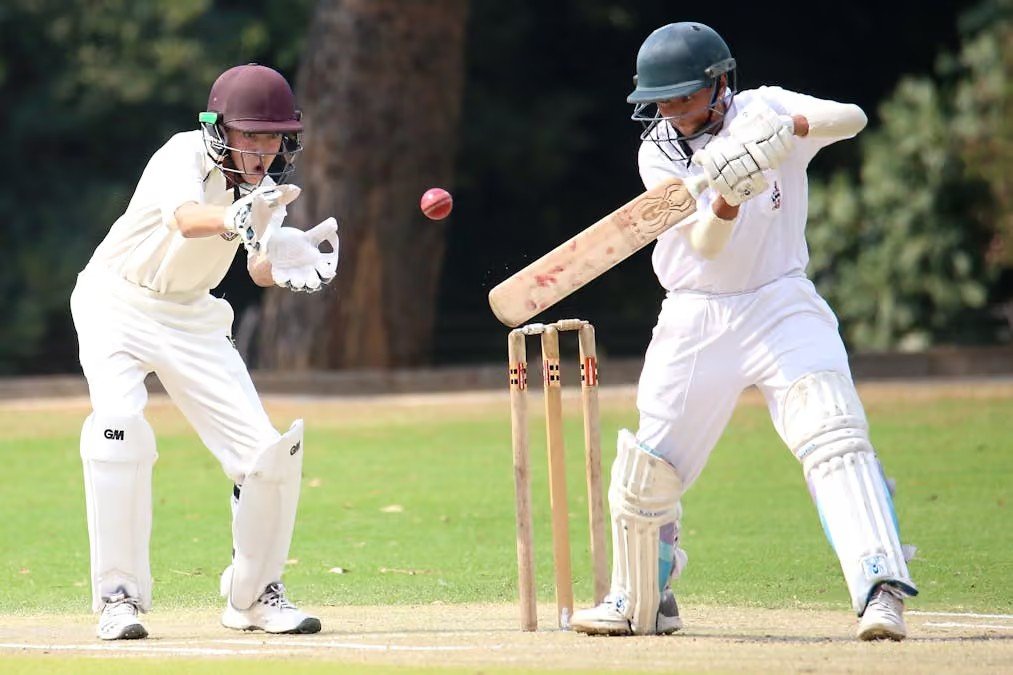
Source Image: Orchidsinternationalschool
Here is a quick overview of the major historical developments that transformed cricket from a simple outdoor game into an international sport.
| Year | Cricket History |
| Around 1550 | John Derrick and his school friends reportedly played cricket in Guildford. |
| 1598 | Guildford court record documented John Derrick’s testimony. |
| 1611 | Two men in Sussex were prosecuted for playing cricket on Sunday instead of attending church, providing an early reference to adult cricket. |
| 1709 | A documented match involved teams identified by county names. |
| 1721 | Earliest recorded reference to cricket in India, at Cambay. |
| 1727 | The Duke of Richmond and Alan Brodrick drew up Articles of Agreement for wagered matches. |
| 1744 | First generally accepted written Laws of Cricket were established. |
| 1771 | The Monster Bat Incident involving Thomas White highlighted the need for a maximum bat width. |
| 1774 | Important amendments included the LBW rule, maximum bat width of 4¼ inches and ball weight of 5.5 to 5.75 ounces. |
| 1775 | Lumpy Stevens beat John Small three times through the two-stump wicket, helping lead to agreement on a third stump. |
| 1776 | First recorded match using three stumps took place between Chertsey and Coulsdon. |
| 1787 | Marylebone Cricket Club (MCC) was founded. Thomas Lord established his original cricket ground. |
| 1788 | MCC issued a revised code of cricket laws. |
| 1803 | First recorded cricket match in Australia. |
| 1806 | Earliest known advertised cricket game in Barbados. |
| 1808 | First recognised cricket match in South Africa. |
| 1832 | First recorded cricket match in New Zealand. |
| 1877 | First men’s Test match between Australia and England. |
Conclusion:
Cricket has no officially recognised inventor. The game developed gradually over several centuries in south-east England, with its earliest possible origins dating back to Saxon or Norman times.
The 1598 Guildford court record provides the earliest definite documentary evidence of cricket, referring to a game played around 1550 by John Derrick and his school friends.
During the 18th century, the Hambledon Club helped establish cricket as a competitive sport. The development of written Laws in 1744, important rule changes in 1774, the introduction of the third stump following the 1775 incident, and the formation of MCC in 1787 helped transform the game into an organised sport.
Cricket subsequently spread across the world through British trade, migration and colonial influence. India, Australia, the West Indies, South Africa and New Zealand became important centres of the sport.
Although England provided cricket’s historical foundations, generations of players and communities across the world helped transform it into one of the most popular sports internationally.
Frequently Asked Questions About Who Invented Cricket
No single person invented cricket. The sport developed gradually in south-east England, possibly during Saxon or Norman times. Its earliest known origins are associated with children playing simple bat-and-ball games in the Weald region.
England is recognised as the birthplace of cricket. Historical evidence connects the early development of the sport with the Weald and other areas of south-east England.
Cricket may have existed during Saxon or Norman times. However, the earliest definite documentary evidence comes from a 1598 legal record in Guildford, Surrey. John Derrick’s testimony suggests that he played the game around 1550.
British East India Company mariners helped introduce cricket to India during the 18th century. The earliest recorded reference dates from 1721, when British sailors reportedly played cricket at Cambay (modern-day Khambhat), near Baroda in present-day Gujarat.
The first generally accepted written Laws of Cricket were established in 1744 by members associated with the Star and Garter Club. Earlier match-specific agreements existed, including the 1727 Articles of Agreement between the Duke of Richmond and Alan Brodrick. The Marylebone Cricket Club (MCC), founded in 1787, later became the principal custodian of cricket’s Laws.