
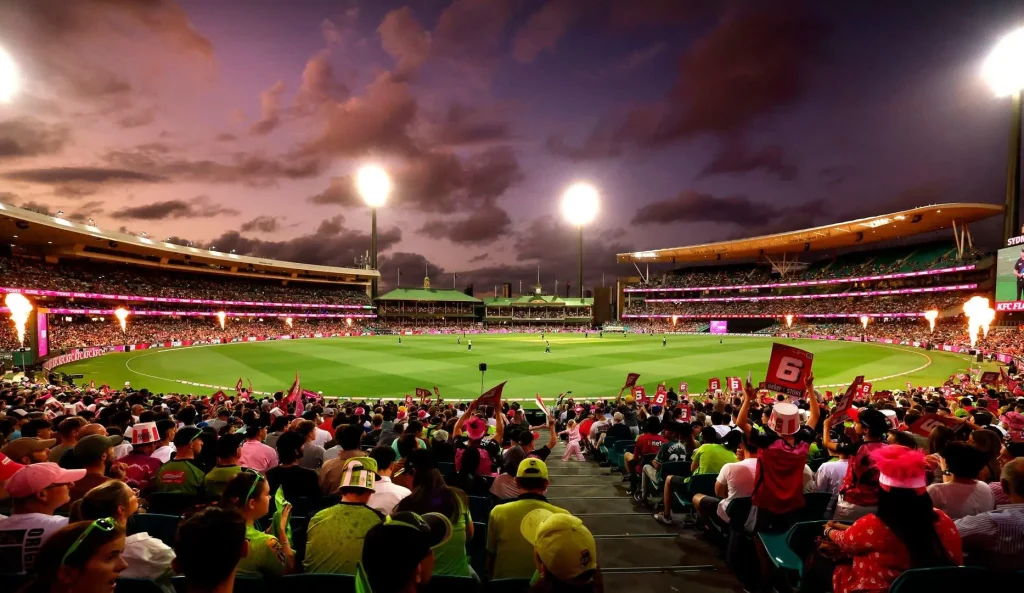
A cricket ground does not have one fixed size. Unlike a football field, its playing area can vary from one stadium to another. The shape may be oval, circular or slightly irregular, and the boundary distance can differ in every direction.
However, international cricket follows specific boundary requirements set by the International Cricket Council (ICC).
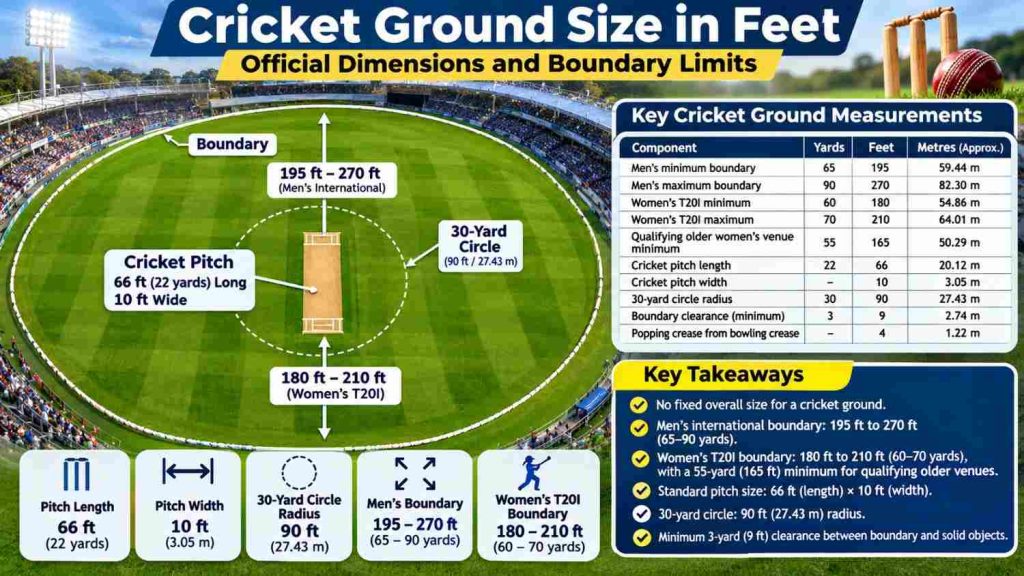
For men’s international cricket, the boundary should generally be between 195 feet and 270 feet from the centre of the pitch. In women’s ODI and T20 international cricket, the general boundary range is 180 feet to 210 feet, with qualifying older venues permitted to use a 165-foot minimum.
The cricket pitch itself has standard dimensions of 66 feet long and 10 feet wide.
Understanding these measurements helps explain why some cricket stadiums have shorter boundaries, why sixes are easier to hit at certain venues, and how ground dimensions affect batting and fielding.
This guide covers official cricket ground size in feet, pitch measurements, international boundary limits, field markings and the differences between men’s and women’s international cricket.
What Is the Standard Cricket Ground Size in Feet?
There is no officially fixed overall measurement for a cricket ground. The ICC regulates boundary distances for international matches, but it does not require every stadium to have the same diameter or shape.
For men’s international ODI and T20I cricket, the general boundary requirement is between 65 yards and 90 yards from the centre of the pitch being used.
Converted into feet, these measurements are:
- Minimum boundary distance: 195 feet (65 yards).
- Maximum boundary distance: 270 feet (90 yards).
- Standard cricket pitch length: 66 feet (22 yards).
- Standard cricket pitch width: 10 feet.
For men’s Test cricket, the minimum straight boundary is 70 yards (210 feet), while the shorter square boundary must be at least 65 yards (195 feet). The maximum boundary is 90 yards (270 feet).
For women’s ODI and T20 international cricket, the general boundary range is 60 to 70 yards (180 to 210 feet). Qualifying older venues may receive an exemption allowing a minimum boundary of 55 yards (165 feet).
These figures describe boundary distances measured from the centre of the pitch, not the total diameter or length of a stadium.
Cricket Ground Size in Feet: Complete Measurement Table
The following table brings together the important measurements used in cricket. It separates fixed pitch dimensions from boundary requirements and fielding markings.
| Cricket Ground Component | Measurement in Yards | Measurement in Feet | Approx. Measurement in Metres |
| Men’s minimum boundary distance | 65 yards | 195 feet | 59.44 m |
| Men’s maximum boundary distance | 90 yards | 270 feet | 82.30 m |
| Men’s Test minimum straight boundary | 70 yards | 210 feet | 64.01 m |
| Men’s Test minimum shorter square boundary | 65 yards | 195 feet | 59.44 m |
| Women’s ODI minimum boundary distance | 60 yards | 180 feet | 54.86 m |
| Women’s ODI maximum boundary distance | 70 yards | 210 feet | 64.01 m |
| Women’s T20I minimum boundary distance | 60 yards | 180 feet | 54.86 m |
| Women’s T20I maximum boundary distance | 70 yards | 210 feet | 64.01 m |
| Qualifying older women’s international venue minimum | 55 yards | 165 feet | 50.29 m |
| Cricket pitch length | 22 yards | 66 feet | 20.12 m |
| Cricket pitch width | — | 10 feet | 3.05 m |
| Men’s 30-yard fielding circle radius | 30 yards | 90 feet | 27.43 m |
| Women’s fielding restriction circle radius | 25.15 yards | 75.45 feet | 23 m |
| Close-infield circle radius | 15 yards | 45 feet | 13.72 m |
| Minimum clearance between boundary rope and solid objects | 3 yards | 9 feet | 2.74 m |
| Popping crease distance in front of bowling crease | — | 4 feet | 1.22 m |
Important: The 55-yard women’s boundary figure is an exemption for qualifying older international venues. It is not the standard minimum for all women’s international matches.
Boundary distances are measured from the centre of the pitch being used. The men’s 30-yard circle and women’s 25.15-yard circle are fielding restriction markings, while the 15-yard circle marks the close-infield area. The 3-yard clearance is a player-safety requirement. None should be confused with the overall size of a cricket ground.
What Are the Official Cricket Boundary Dimensions?
The boundary determines the outer limit of the playing area. It is usually marked with a rope placed around the outfield.
For men’s international cricket, the general ICC requirement is a minimum boundary distance of 65 yards (195 feet) and a maximum of 90 yards (270 feet), measured from the centre of the pitch being used.
The aim is to provide the largest practical playing area at each venue while maintaining the required safety clearance.
Men’s International Cricket Boundary Size
| Boundary Measurement | Yards | Feet | Metres |
| Minimum | 65 | 195 | 59.44 |
| Maximum | 90 | 270 | 82.30 |
These requirements apply to men’s international limited-overs cricket. Previously approved international venues that cannot meet the applicable minimum boundary distance may qualify for an exemption.
For men’s Test cricket, the straight boundary must be at least 70 yards (210 feet), while the shorter square boundary must be at least 65 yards (195 feet). The maximum boundary is 90 yards (270 feet).
The minimum and maximum distances are measured from the centre of the pitch being used, not from the centre of the stadium.
This explains why two stadiums can have noticeably different playing areas even when they host the same international format.
Women’s International Cricket Boundary Size
Women’s international cricket has different boundary requirements from men’s cricket.
Under the ICC Women’s ODI and T20I playing conditions, the boundary should be at least 60 yards (180 feet) and no more than 70 yards (210 feet) from the centre of the pitch being used.
Certain previously approved venues that cannot meet the 60-yard minimum may qualify for an exemption. Under the relevant provisions, a minimum boundary distance of 55 yards (165 feet) can apply to qualifying older grounds.
The ICC Women’s T20I Playing Conditions issued in June 2023 specify the 60-yard general minimum and the exemption for qualifying older venues. This replaced the earlier arrangement in which 55 yards was the minimum and 60 yards was the preferred target where possible.
These measurements apply to women’s limited-overs international cricket. Women’s Test matches follow their separate Test playing conditions.
Cricket Pitch Size in Feet
The cricket pitch is the central playing strip where the bowler delivers the ball and the batter attempts to score runs.
Unlike the overall cricket ground, the pitch has fixed dimensions under the Laws of Cricket.
According to Law 6 of the MCC Laws of Cricket, a standard cricket pitch measures:
- Length: 66 feet (22 yards or approximately 20.12 metres).
- Width: 10 feet (approximately 3.05 metres).
The pitch length is measured between the two bowling creases. The width extends across the prepared rectangular playing surface.
Important Cricket Pitch Markings
Several markings help players and officials apply the rules during a match.
| Pitch Marking | Measurement |
| Pitch length | 66 feet |
| Pitch width | 10 feet |
| Popping crease from bowling crease | 4 feet |
| Distance between the two bowling creases | 66 feet |
The popping crease is marked 4 feet in front of and parallel to the bowling crease. It helps officials determine whether a batter is safely inside the crease and whether a bowler has delivered a legal ball.
The bowling crease is the reference marking at each end of the pitch. The two bowling creases are 22 yards apart.
What Is the 30 Yard Circle in Cricket?
The 30-yard circle is a field marking used in limited-overs cricket, particularly One Day Internationals and T20 matches.
In men’s limited-overs international cricket, its radius is 30 yards, equivalent to 90 feet or approximately 27.43 metres.
Women’s international limited-overs cricket uses a smaller fielding restriction circle. Its radius is 25.15 yards (75.45 feet or 23 metres).
The marking consists of two semicircles connected by straight lines running parallel to the pitch. The middle stump at each end acts as the centre for its respective semicircle.
The circle plays an important role in fielding restrictions.
During powerplay overs, the number of fielders allowed outside the circle is restricted. The exact limits depend on the match format and whether the match is men’s or women’s cricket.
T20I Fielding Restrictions
Men’s T20I cricket:
- Powerplay (overs 1–6): Maximum two fielders outside the circle.
- Non-powerplay (overs 7–20): Maximum five fielders outside the circle.
Women’s T20I cricket:
- Powerplay (overs 1–6): Maximum two fielders outside the circle.
- Non-powerplay (overs 7–20): Maximum four fielders outside the circle.
ODI Fielding Restrictions
Men’s ODI cricket:
- Powerplay 1 (overs 1–10): Maximum two fielders outside the circle.
- Powerplay 2 (overs 11–40): Maximum four fielders outside the circle.
- Powerplay 3 (overs 41–50): Maximum five fielders outside the circle.
Women’s ODI cricket:
- Powerplay 1 (overs 1–10): Maximum two fielders outside the circle.
- Remaining overs (overs 11–50): Maximum four fielders outside the circle.
The purpose of these restrictions is to maintain a balance between batting and bowling. They encourage attacking cricket while preventing the fielding team from placing too many players on the boundary.
The 30-yard circle is an internal fielding restriction marking. It is not the boundary of the cricket ground. Women’s international cricket uses the smaller 25.15-yard circle instead.
What Is the 15 Yard Circle in Cricket?
The 15-yard circle marks the close-infield area around the pitch. Its radius is 15 yards (45 feet or approximately 13.72 metres), measured from the middle stump guard on the popping crease.
It identifies the inner area of the field and helps distinguish close-infield positions from the larger fielding restriction circle.
The 15-yard circle is different from both the men’s 30-yard circle and the women’s 25.15-yard fielding restriction circle. It is an additional field marking used to identify the close-infield area.
Cricket Ground Size Example: Narendra Modi Stadium
Source Image : sports-facility
The Narendra Modi Stadium in Ahmedabad is a useful example of how cricket ground dimensions can vary according to the pitch and boundary rope position.
During the India versus Netherlands match on 18 February 2026 in the ICC Men’s T20 World Cup, the pitch report provided the following approximate boundary distances:
- Straight boundary: 70 metres (approximately 229.66 feet).
- Shorter leg-side boundary: 60 metres (approximately 196.85 feet).
- Opposite square-side boundary: 68 metres (approximately 223.10 feet).
These figures demonstrate that boundary distances are not necessarily equal in every direction. The straight boundary was longer than the shorter leg-side boundary for the reported batting position.
They are match-specific measurements rather than permanent dimensions for every match at the stadium. Boundary ropes can be repositioned depending on the pitch and match conditions.
For more details, read our Narendra Modi Stadium Boundary Size and Full Ground Dimensions guide.
Why Does Cricket Ground Size Vary Between Stadiums?
Cricket stadiums do not follow one universal shape or overall diameter. Several practical factors influence their dimensions.
Available Land: Stadium construction depends on the land available. Urban venues may have limited space, while grounds outside crowded cities can accommodate larger playing areas.
Ground Shape: Some cricket grounds are almost circular, while others are elongated ovals or irregular shapes. As a result, the distance between the pitch and boundary changes around the field.
Stadium Design: Seating arrangements, stands, sight screens, safety areas and surrounding structures influence where the playing boundary can be positioned.
Match Format: Boundary ropes may be moved between matches and formats, subject to the relevant playing conditions. A stadium can therefore have different boundary distances for different games.
Venue Regulations: International matches must follow the relevant ICC playing conditions. Domestic, school and club cricket may operate under different competition rules.
These factors explain why a stadium should not be judged by its seating capacity alone. A large stadium does not automatically have the largest playing area.
It is also important to distinguish the stadium’s overall size from the playing area, boundary distance, pitch dimensions and fielding circles. These are separate measurements.
How Cricket Ground Size Affects a Match
Ground dimensions can influence the way teams approach a cricket match.
Short Boundaries: Batters can clear the rope more easily with powerful shots. Misjudged hits may also travel over the boundary, increasing the possibility of sixes.
Long Boundaries: Batters need greater power to hit sixes. Fielders have more opportunities to catch balls that might clear the rope at a smaller venue.
Uneven Boundary Distances: Some grounds have shorter straight boundaries and longer square boundaries. Batters may target the shorter side, while bowlers adjust their line and length to reduce scoring opportunities.
Fielding Strategy: Captains consider boundary distances when positioning fielders. They may protect shorter boundaries or leave more space in areas where batters find it difficult to hit sixes.
Ground dimensions do not decide the result of a match, but they can influence tactics, scoring patterns and player performance.
Conclusion
Cricket ground size in feet varies depending on the stadium, match format and applicable playing conditions. There is no single official measurement for the overall ground.
For men’s international cricket, the general boundary distance ranges from 195 feet to 270 feet. Men’s Test cricket also requires a minimum straight boundary of 210 feet and a minimum shorter square boundary of 195 feet.
Women’s ODI and T20 international cricket generally have a boundary range of 180 feet to 210 feet, with qualifying older venues potentially subject to a 165-foot minimum.
The cricket pitch maintains standard dimensions of 66 feet long and 10 feet wide.
The men’s 30-yard circle has a radius of 90 feet, while the women’s fielding restriction circle has a radius of 75.45 feet. The 15-yard close-infield circle has a radius of 45 feet.
Understanding these measurements makes it easier to compare cricket grounds, understand boundary rules and see how playing conditions influence the game.
Frequently Asked Questions About Cricket Ground Size in Feet
There is no fixed overall size for a cricket ground. For men’s international cricket, the general boundary distance should be between 195 feet and 270 feet from the centre of the pitch. The actual playing area varies by stadium.
A standard cricket pitch is 66 feet long and 10 feet wide. Its length is equivalent to 22 yards. These dimensions are specified under the Laws of Cricket.
For men’s international cricket, the general minimum boundary distance is 195 feet (65 yards) from the centre of the pitch. For women’s ODI and T20 internationals, the general minimum is 180 feet (60 yards), with qualifying older venues permitted to use a 165-foot minimum.
For men’s international cricket, the general maximum boundary distance is 270 feet (90 yards). For women’s ODI and T20 internationals, the maximum is 210 feet (70 yards). These measurements are taken from the centre of the pitch being used.
No. Cricket stadiums differ in shape, playing area and boundary distances. Available land, stadium architecture, safety requirements and competition regulations all influence their dimensions. Even the same stadium can have different boundary positions for different matches.